


 Arabic (UAE)
FA-9500 Multi-Purpose Signal Processor 3G/HD/SD


The FA-9500 Multi-Purpose Signal Processor 3G/HD/SD from For-A is a one-stop shop for signal processing within your facility. The FA-9500 features two 3G-SDI inputs alongside a wide variety of other video and audio inputs, outputs, and processing functions.
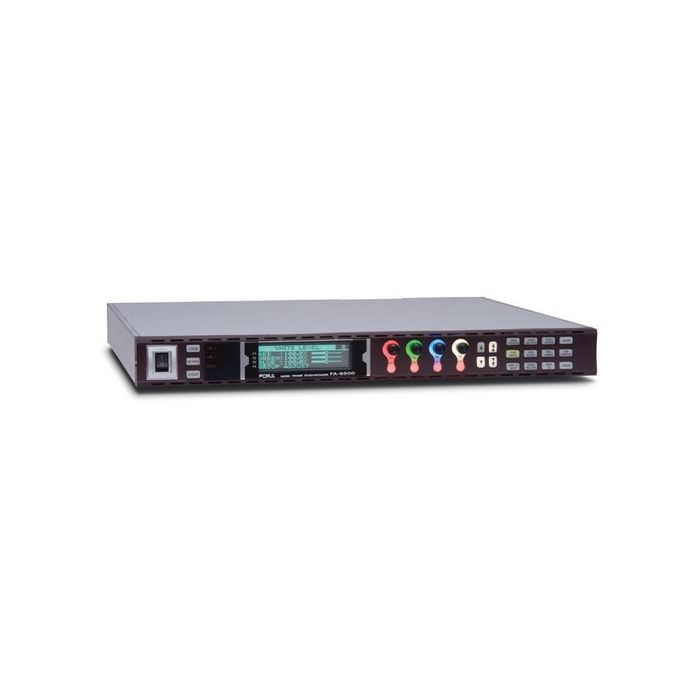
The FA-9500 Multi-Purpose Signal Processor 3G/HD/SD from For-A is a one-stop shop for signal processing within your facility. The FA-9500 features two 3G-SDI inputs alongside a wide variety of other video and audio inputs, outputs, and processing functions. Suitable for both 60Hz and 50Hz regions, the signal processor supports emerging video formats via the 3G-SDI inputs and outputs, making it a future-proof link in your signal chain.
The FA-9500 is an upconverter, a downconverter, a cross-converter, an aspect ratio converter. It's a frame synchronizer, a color corrector, an automatic video optimizer. It does SD. It does all the popular flavors of HD. It does analog and digital versions of both. Optionally, it can handle optical video signals and function as a frame-rate converter and logo generator, among other possibilities. Analog HD/SD component I/O with Y/C is a future option. For seamless integration into your facility, the FA-9500 signal processor can be monitored and controlled over the web.
Multi-Format Video I/O
Standard with the FA-9500 are three video inputs: two 3G/HD/SD-SDI inputs, and one analog composite input. The 3G-SDI I/O makes possible full processing of 3Gb/s signals such as 1080p. You can add up to two additional inputs, allowing you to choose one channel from the total of five inputs. The two SDI channels are synchronously coupled independently, meaning that during switch-over there is no "shock" to either the video or audio. Each SDI input has error detection, which enables the system to effect a seamless switch to the other channel when an error is detected or a signal is lost. Input signals pass through a converter circuit of two internal channels and get output as SDI and analog component signals. Each channel has two distributed outputs. SDI and analog composite inputs all enjoy an I/O bypass function in case power is cut.
Frame Synchronizer
Key to the performance of a frame synchronizer is its facility for handling poor-quality video signals. The FA-9500 inherits For-A's well-established proficiency for handling subpar signals and features three modes for synchronization: Frame, Line, and Input. In Line Synchronizer mode, the FA-9500 operates as AVDL to auto-adjust the input signal (adjustment range: 5H in HD, 1H in SD). In each mode, ancillary data can be passed through with both horizontal and vertical. (Note: when input/output formats differ, there are limitations on the packets that can be passed through.) The FA-9500 also handles video delay.
Signal Conversion
One of the FA-9500's areas of strength is its versatility at signal conversion. It does digital-to-analog conversion as well as analog-to-digital. In terms of resolution, it goes up, down, and across, and it does aspect-ratio conversion to boot. The FA-9500 does mutual conversion of not only HD and SD but also the 1080i and 720p HD formats. A second conversion channel handles down/cross/aspect-ratio conversion, but does not do up-conversion. This second channel comes in handy when a simultaneous SD output is needed.
Automatic Video Optimizer (AVO)
The Automatic Video Optimizer (AVO) function is ideal for correcting over- or underexposed video. AVO monitors video and in real time sets various video parameters to normal levels, including the white level, black level, and gamma curve. AVO's dynamic range correction recognizes dark and bright areas in video and makes corrections only to those areas that need it, resulting in better-viewable video with a wider dynamic range. You can set the range to which the level adjustments will apply – for instance, set a level that will trigger the correction of dark areas. The module's mask function allows you to set aside areas within the source video that are unnecessary to monitor, such as sections where captions will be displayed.
Color Corrector
The frame synchronizer also features a color correction function with three modes. Balanced mode is designed for correction of RGB signals. Differential mode allows you to correct colors without affecting the signal's white balance (for YPbPr signals). Sepia mode can be used to effect a monochrome color scheme. You can also apply existing colors to a selected color space using either gamma adjustment (with high, mid, and low tones) or various level adjustments. The FA-9500 features various clip functions (Y white, C white, Y black) and a 2D/3D comb filter for Y/C separation.
Audio I/O
The FA-9500 provides 16 synchronous/asynchronous channels of embedded audio, 8 channels of AES/EBU, and 4 channels of analog audio, adding up to a total of 28 input signals and 28 output signals. (That's the total possible in HD. In SD, only synchronous audio is supported, and at most there can be 16 input and 12 output channels.)
Audio Signal Processing
The signal processor offers many functions for audio processing, including embedding with and de-embedding from video signals, and A/D and D/A conversion. Each audio channel has an individual sampling-rate converter. Multi-channel audio is also flexibly supported: the audio signal can be from embedded SDI, AES/EBU, analog, or a mix of those. For processes such as delay adjustment, level adjustment, down-mixing, and remapping, signal processing without any phase gap between channels is possible.
Optional I/O
With the FA-9500, For-A offers a broad range of options for formats and functions. To the standard supported I/O formats you can add optical video (OE), and on the audio side, Dolby Digital (input only) and Dolby E. You can also add two extra video input channels for a total of five. For-A plans to offer HD/SD analog component I/O with Y/C as a future option.
Optional Functions
Frame rate conversion, based on technology developed for For-A's FRC series, is an optional function of the FA-9500. For monitoring and control of the device over a network, you can add SNMP monitoring. An optional logo generator lets you impose images, such as corporate logo or a graphical side panel for 4:3 video, over video. The logo data is maintained even when the FA-9500 is powered off.